


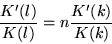
The modular equation of degree n gives an algebraic connection of the form
 |
(1) |
between the transcendental complete elliptic integrals of the first kind with moduli k and l. When k and l satisfy a modular equation, a relationship of the form
 |
(2) |
exists, and M is called the multiplier. In general, if p is an odd prime, then the modular equation is given by
 |
(3) |
where
 |
(4) |
 is a elliptic lambda function, and
 |
(5) |
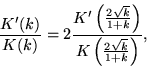
(Borwein and Borwein 1987, p. 126). An elliptic integral identity gives
 |
(6) |
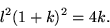
so the modular equation of degree 2 is
 |
(7) |
which can be written as
 |
(8) |
A few low order modular equations written in terms of k and l are
 |
(9) |
 |
(10) |
 |
|
| (11) |
 |
 |
 |
(12) |
 |
|
 |
|
|
 |
||
| (13) | |||
 |
|
 |
(14) |
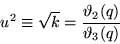
where
 |
(15) |
and
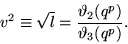 |
(16) |
Here,  are Jacobi theta functions.
A modular equation of degree  for
for  can be obtained by iterating the equation for
  .
.
Quadratic modular identities include
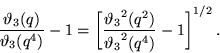 |
(17) |
Cubic identities include
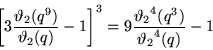 |
(18) |
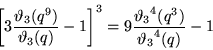 |
(19) |
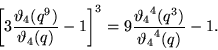 |
(20) |
A seventh-order identity is
 |
(21) |
From Ramanujan (1913-1914),
 |
(22) |
 |
(23) |
When k and l satisfy a modular equation, a relationship of the form
|
(24) |
exists, and M is called the multiplier. The multiplier of degree n can be given by
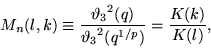 |
(25) |
where is a Jacobi theta function and K(k) is a complete elliptic integral of the first kind.
The first few multipliers in terms of l and k are
 |
|
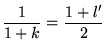 |
(26) |
 |
|
 |
(27) |
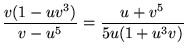
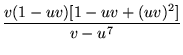
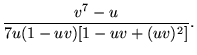
In terms of the u and v defined for modular equations,
 |
|
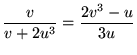 |
(28) |
 |
|
 |
(29) |
 |
|
 |
|
|
 |
(30) |

Modular Form, Modular Function, Schläfli's Modular Form


Borwein, J. M. and Borwein, P. B. Pi & the AGM: A Study in Analytic Number Theory and Computational Complexity. New York: Wiley, pp. 127-132, 1987.
Hanna, M. "The Modular Equations." Proc. London Math. Soc. 28, 46-52, 1928.
Ramanujan, S. "Modular Equations and Approximations to  .
.