


A homework problem proposed in Steffi's math class In January 2003 asked students to prove that no ratio of two unequal numbers obtained by permuting all the digits 1, 2, ..., 7 results in an integer. If such a ratio r existed, then some permutation of 1234567 would have to be divisible by r. r can immediately be restricted to  ,
, ,
, .
.
This leaves only the cases r = 2, 4, and 5 to consider. The r = 5 case can be eliminated by noting that in order to be divisible by 5, the last digits of the numerator and denominator must be 5 and 1, respectively

The largest possible ratio that can be obtained will then use the largest possible number in the numerator and the smallest possible in the denominator, namely

But  ,
,
In general, consider the numbers of pairs of unequal permutations of all the digits  in base b (k < b) whose ratio is an integer. Then there is a unique
  solution

a unique  solution

three  solutions
 |
 |
 |
|
 |
|
 |
|
 |
|
 |
and so on.
The number of solutions for the first few bases and numbers of digits k are summarized in the table below (Sloane's A80202).
| b | solutions for digits  , , , , |
| 3 | 0 |
| 4 | 0, 1 |
| 5 | 0, 0, 1 |
| 6 | 0, 0, 3, 25 |
| 7 | 0, 0, 0, 2, 7 |
| 8 | 0, 0, 0, 0, 68, 623 |
| 9 | 0, 0, 0, 0, 0, 124, 1183 |
| 10 | 0, 0, 0, 0, 0, 0, 2338, 24603 |
| 11 | 0, 0, 0, 0, 0, 0, 3, 598, 5895 |
| 12 | 0, 0, 0, 0, 0, 0, 0, 0, 161947, 2017603 |
As can be seen from the table, in base 10, the only solutions are for the digits 12345678 and 123456789. Of the solutions for  ,
,
 |
|
 |
|
 |
|
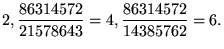 |
Taking the diagonal entries  from this list for b = 3, 4, ... gives the sequence 0, 1, 1, 25, 7, 623, 1183, 24603, ... (Sloane's A80203).

Divisibility Tests, Pandigital Fraction


Sloane, N. J. A. Sequences A80202 and A80203 in "The On-Line Encyclopedia of Integer Sequences." http://www.research.att.com/~njas/sequences/.