













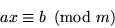
A linear congruence equation
 |
(1) |
is solvable iff the congruence
 |
(2) |
is solvable, where
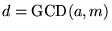 is the greatest common divisor. Let one solution to the original equation
be
is the greatest common divisor. Let one solution to the original equation
be  .
. ,
, ,
, ,
,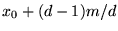 .
. .
.
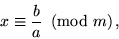
Solution to a linear congruence equation is equivalent to finding the value of a fractional congruence, for which a greedy-type algorithm exists. In particular, (1) can be rewritten as
 |
(3) |
which can also be written
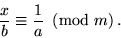 |
(4) |
In this form, the solution x can be found as Mod[b y, m] of the solution y returned by the Mathematica command y=PowerMod[a, -1, m]. This is known as a modular inverse.
Two or more simultaneous linear congruences
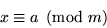 |
(5) |
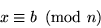 |
(6) |
are solvable using the Chinese remainder theorem.
 Chinese Remainder Theorem, Congruence, Congruence Equation, Modular Inverse, Quadratic Congruence Equation


Nagell, T. "Linear Congruences." §23 in Introduction to Number Theory. New York: Wiley, pp. 76-78, 1951.

 |
|||

|

|
||