


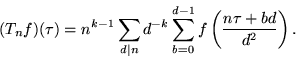
A family of operators mapping each space  of modular forms onto itself. For a fixed integer k and any positive integer n, the Hecke operator
  is defined on the set of entire modular forms of weight k by
 |
(1) |
For n a prime p, the operator collapses to
 |
(2) |
If  has the Fourier series
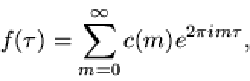 |
(3) |
then  has Fourier series
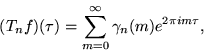 |
(4) |
where
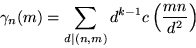 |
(5) |
(Apostol 1997, p. 121).
If  ,
,
 |
(6) |
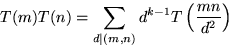
Any two Hecke operators T(n) and T(m) on commute with each other, and moreover
 |
(7) |
(Apostol 1997, pp. 126-127).
Each Hecke operator has eigenforms when the dimension of is 1, so for k = 4, 6, 8, 10, and 14, the eigenforms are the Eisenstein series  ,
, ,
, ,
, ,
, , has eigenforms when the dimension of the set of cusp forms
  is 1, so for k = 12, 16, 18, 20, 22, and 26, the eigenforms are
  ,
, ,
, ,
, ,
, ,
, , is the modular discriminant of the Weierstrass elliptic function (Apostol 1997, p. 130).


Apostol, T. M. "The Hecke Operators." §6.7 in Modular Functions and Dirichlet Series in Number Theory, 2nd ed. New York: Springer-Verlag, pp. 120-122, 1997.