


In his monumental treatise Disquisitiones Arithmeticae, Gauss  conjectured that the class number
  of an imaginary quadratic field with binary quadratic form discriminant
  tends to infinity with d. A proof was finally given by Heilbronn (1934), and Siegel (1936) showed that for any
  ,
, such that
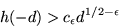
as  . such that
  ,
,
Goldfeld (1976) showed that if there exists a "Weil curve" whose associated Dirichlet L-series has a zero of at least third order at s = 1, then for any , such that
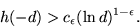
Gross and Zaiger (1983) showed that certain curves must satisfy the condition of Goldfeld, and Goldfeld's proof was simplified by Oesterlé (1985).

Class Number, Gauss's Class Number Problem, Heegner Number


Arno, S.; Robinson, M. L.; and Wheeler, F. S. "Imaginary Quadratic Fields with Small Odd Class Number." http://www.math.uiuc.edu/Algebraic-Number-Theory/0009/.
Böcherer, S. "Das Gauß'sche Klassenzahlproblem." Mitt. Math. Ges. Hamburg 11, 565-589, 1988.
Gauss, C. F. Disquisitiones Arithmeticae. New Haven, CT: Yale University Press, 1966.
Goldfeld, D. M. "The Class Number of Quadratic Fields and the Conjectures of Birch and Swinnerton-Dyer." Ann. Scuola Norm. Sup. Pisa 3, 623-663, 1976.
Gross, B. and Zaiger, D. "Points de Heegner et derivées de fonctions L." Comptes Rendus Acad. Sci. Paris 297, 85-87, 1983.
Heilbronn, H. "On the Class Number in Imaginary Quadratic Fields." Quart. J. Math. Oxford Ser. 25, 150-160, 1934.
Oesterlé, J. "Nombres de classes des corps quadratiques imaginaires." Astérique 121-122, 309-323, 1985.
Siegel, C. L. "Über die Klassenzahl quadratischer Zahlkörper." Acta. Arith. 1, 83-86, 1936.